Hyundai Ioniq 5 review for Colorado buyers
The Ioniq 5 charges faster than most EVs at a high-power station, which makes I-70 ski trips easier, and Hyundai's 10-year/100,000-mile EV battery warranty is a real plus for used buyers. EPA range runs from 220 to 318 miles depending on year and version. The 2025 refresh added bigger batteries and a native NACS port. On 2022-2024 cars, the ICCU recall is the first thing to verify.
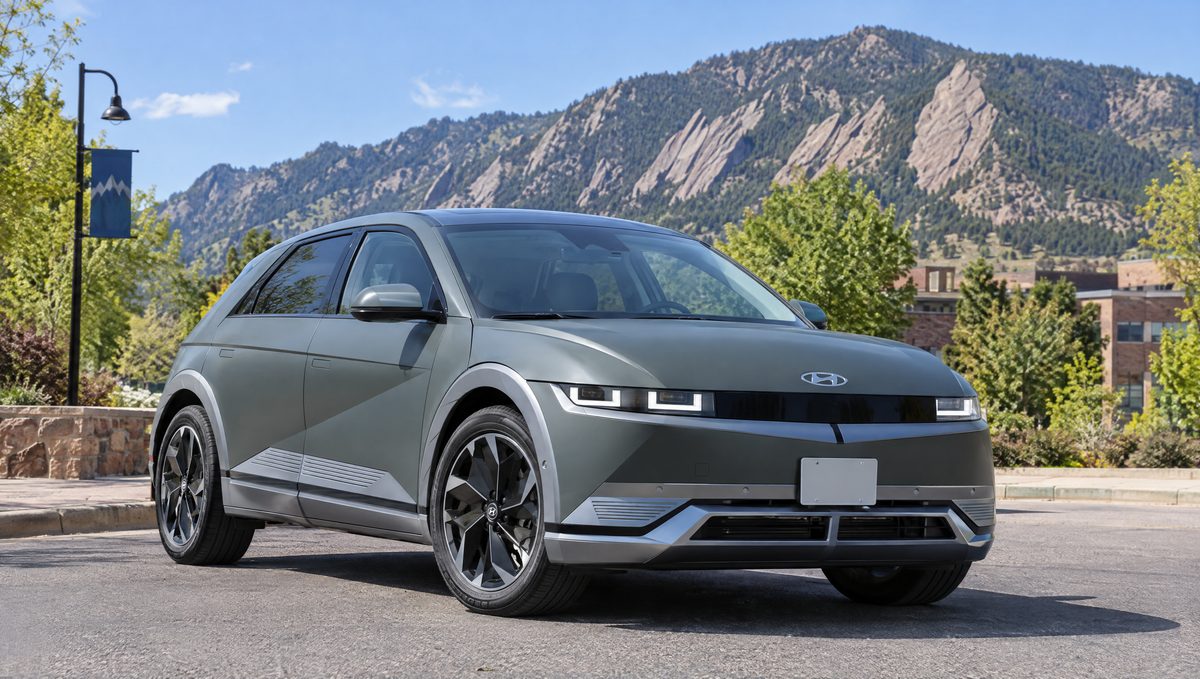
AI-generated illustration of a Hyundai Ioniq 5, not a specific vehicle for sale.
Verdict
- Ski commuters who want quick fast-charge stops
- Used EV buyers who value a long battery warranty
- Buyers who want AWD in a roomy two-row EV
- Dirt-road trailhead runs in the XRT
- You need to tow a camper
- You're buying a 2022-2024 without proof the ICCU recall is done
- You can't charge at home
- You need a third row
How it fits Colorado
Scored 1 to 5 for the way people here actually drive. These are our judgments, based on the facts below. Select a rating for the reasoning.
-
Dual-motor AWD is available every year and battery heating is standard on later cars, but range falls in the cold like any EV.
-
Electric motors keep full power at altitude, and strong regen recovers energy coming down from the passes.
-
This isn't a tow vehicle; Hyundai's ratings are light and vary by year and equipment, so check the owner's manual for the specific car.
-
Standard versions are low; the 2025 XRT adds a 23mm lift and all-terrain tires, which helps on washboard roads to trailheads.
-
EPA efficiency of 94 to 115 MPGe on non-N versions, and home charging covers daily driving.
-
Roomy for five with a flat floor, but cargo space is less than a three-row SUV.
Which Ioniq 5 generation to look at
First generation, refreshed 2025-present
For 2025 Hyundai enlarged the batteries (to 63 and 84 kWh), added a native NACS port with a CCS adapter included, introduced the XRT and started building the Ioniq 5 in Georgia. EPA range runs from 245 miles (Standard Range) to 318 miles (RWD), with AWD versions at 259 to 290; the high-performance Ioniq 5 N is rated at 221.
- Recalls 25V-482 and 26V-068: a high-voltage battery bus bar may be improperly tightened and cause a short circuit on some 2025-2026 cars
- Recalls 25V-605 and 26V-314: rear suspension fasteners on some 2025 cars may loosen
- Recall 25V-797: front seat belt retractors on some 2025 cars may not be securely fastened
- Recall 25V-064: an open circuit in rear floor wiring may keep a rear side air bag from deploying on some 2025 cars
- Ioniq 5 N: recalls 25V-065 and 25V-235 for brake software with left-foot braking features
First generation, early cars 2022-2024
Launched for 2022 with a 58 kWh Standard Range or 77.4 kWh Long Range battery, RWD or AWD, and a CCS port. EPA range runs from 220 miles (Standard Range RWD) to 303 miles (Long Range RWD), with AWD at 256 to 260.
- Recalls 24V-204 and 24V-868: the Integrated Charging Control Unit (ICCU) can be damaged and stop charging the 12-volt battery, which can lead to a loss of drive power; 24V-868 supersedes the first recall, so cars fixed under 24V-204 need the newer remedy too
- Recall 26V-432: some 2023-2024 high-voltage battery cells may have misaligned electrodes that can lead to a fire
- Recall 24V-065: rear inner driveshaft on some 2023 cars may break under load
- Recall 22V-324: shifter software on some 2022 cars may release the park mechanism
- Heat pump availability varies by year and trim on these cars, so confirm it on the specific vehicle
Hyundai Ioniq 5 specifications
Figures vary by year, trim and configuration. Confirm the exact numbers for any specific vehicle before you rely on them.
- Drivetrain
- Single-motor RWD or dual-motor AWD
- Batteries
- 2022-2024: 58 or 77.4 kWh
- 2025 and later: 63 or 84 kWh
- EPA range
- 220-318 miles depending on year, battery and drivetrain
- AWD versions 256-290 miles
- Ioniq 5 N 221 miles
- EPA efficiency (combined)
- 94-115 MPGe on non-N versions
- Seating
- 5
- Charging
- 800-volt system
- CCS port on 2022-2024, native NACS port with CCS adapter on 2025 and later
- Battery warranty
- 10 years or 100,000 miles on the EV battery, per Hyundai
- Towing (max, properly equipped)
- Light duty only
- Varies by year and equipment, check the owner's manual
The Ioniq 5 for Colorado buyers
Why charging speed matters on I-70
The Ioniq 5's biggest strength is how it charges. It runs an 800-volt system, and Hyundai quotes about 18 minutes to go from 10 to 80 percent on a 350 kW charger. You won't always get that, because many stations deliver less and a cold battery charges more slowly, but the car itself is built to take a lot of power fast.
That changes how a ski day feels. A quick stop on the way up I-70 or on the way back to Denver is shorter than in many EVs. Start the stop with a low battery and with navigation set to the charger, since Hyundai added battery preconditioning that warms the pack when a fast charger is the destination.
The 2025 refresh added a native NACS port, which opens Tesla Superchargers without an adapter, and Hyundai includes a CCS adapter for other networks. On a 2022-2024 car you'll use CCS stations directly; Supercharger access on those years requires an adapter.
Winter range and snow traction
Cold weather costs range on any EV. AAA's 2019 test of five EVs found an average 41 percent range drop at 20 degrees F with the heater on, and about 12 percent with it off. The DOE's fueleconomy.gov says most of that extra energy goes to heating the cabin. Heat pumps help, and on the Ioniq 5 heat pump availability varies by year and trim, so check the car you're looking at.
Hyundai made battery heating standard across the lineup after the first model year. That matters in Colorado because a warm battery charges faster and delivers power better on a frozen morning. Preconditioning while plugged in at home is still the single best habit.
For snow, pick AWD if you live in the foothills or drive the mountains. EPA range on AWD versions runs 256 to 290 miles depending on year and wheels. Put real winter or all-weather tires on it: CDOT's Traction Law requires at least 3/16 inch of tread and an all-weather, M+S or mountain/snowflake rating, or chains or an approved traction device. Our Colorado winter car guide explains tire choices.
Mountain passes, regen and the XRT
Climbing to the Eisenhower Tunnel uses a lot of energy, but the Ioniq 5 gets much of it back on the way down. Regenerative braking slows the car on long grades like the west side of Vail Pass, saving the friction brakes. Regen is limited when the battery is full or very cold, so don't start a big descent at 100 percent if you can avoid it.
Altitude doesn't sap power from electric motors, so the car feels the same in Fairplay as it does in Denver.
The XRT, new for 2025, is the one aimed at Colorado-style use. It's AWD only with the 84 kWh battery, a 23mm suspension lift, all-terrain tires and better approach and departure angles. It's still not a trail rig, but it's better suited to washboard county roads and rutted trailhead lots. EPA range for the XRT is 259 miles. If you want true off-road ability, look at the Rivian R1S.
Buying a used Ioniq 5: the ICCU and battery checks
On 2022-2024 cars, the ICCU recall is the big one. The Integrated Charging Control Unit keeps the 12-volt battery charged, and when it fails the car can eventually lose drive power. Hyundai's remedy is an inspection, replacement of the ICCU and fuse if needed, and a software update. The first recall (24V-204) was superseded by 24V-868, so a car fixed under the first one needs the newer remedy too. Get the VIN checked and ask for dealer records.
The good news for used buyers is the battery warranty. Hyundai lists its EV battery coverage at 10 years or 100,000 miles, and its warranty page shows the same term for subsequent owners. Hyundai's regular powertrain warranty does drop for second owners, so don't confuse the two. Confirm the in-service date to see how much battery coverage remains.
Still check battery health with a dealer report or scan, and compare the full-charge range estimate to the original EPA rating. Look for hail damage on the hood and roof using our hail damage checklist. If you want help, we can find an Ioniq 5 that's had the recall work done and handle the paperwork.
Ioniq 5 versus the other EVs we cover
Against the Tesla Model Y, the Ioniq 5 charges quickly on high-power stations and comes with a longer battery warranty, while the Model Y uses a heat pump, carries a 3,500-pound tow rating and Supercharger access on every car. Against the Ford Mustang Mach-E, the Ioniq 5's used-car story is simpler once the ICCU work is confirmed.
Neither car is a tow vehicle or a three-row family hauler. If that's your need, the Kia Telluride is the gas alternative and the R1S is the electric one.
Pros and cons
- Very fast charging on high-power DC stations
- 10-year/100,000-mile EV battery warranty per Hyundai
- AWD available every year
- 2025 and later cars have a native NACS port
- XRT adds a lift and all-terrain tires for dirt roads
- ICCU recall on 2022-2024 cars needs to be verified
- Not a tow vehicle
- Heat pump availability varies by year and trim
- Low ground clearance on standard versions
- Real winter range falls well below EPA ratings
Looking for a Ioniq 5?
None listed at the moment. Tell us the year range, trim and budget and a broker will look for one that fits.
Hyundai Ioniq 5 questions
Is the Hyundai Ioniq 5 good in Colorado winters?
Yes, as an AWD car on winter or all-weather tires. Battery heating and preconditioning help with cold-morning charging, but range will drop noticeably in deep cold. Check whether the specific car has a heat pump, since availability varies.
Can the Ioniq 5 charge at Tesla Superchargers?
Yes. 2025 and newer Ioniq 5s have a native NACS port that works at Superchargers without an adapter, and Hyundai includes a CCS adapter for other networks. 2022-2024 cars have a CCS port and need a NACS adapter for Superchargers.
What is the Ioniq 5 ICCU problem?
The Integrated Charging Control Unit on 2022-2024 cars can be damaged and stop charging the 12-volt battery, which can eventually cause a loss of drive power. Hyundai recalled the cars (24V-204, then 24V-868) to inspect, replace parts as needed and update software. Make sure the newer 24V-868 remedy is done.
Does a used Ioniq 5 keep the 10-year battery warranty?
Hyundai's warranty page lists the EV battery at 10 years or 100,000 miles for both original and subsequent owners. The general powertrain warranty is shorter for second owners. Confirm the in-service date and read the warranty booklet for that model year.
Is the Ioniq 5 XRT worth it for Colorado?
If you drive dirt roads to trailheads or campsites, it can be. The XRT adds a 23mm lift, all-terrain tires and better approach and departure angles, at the cost of some range (259 miles EPA). For pavement and ski commutes, a regular AWD Ioniq 5 is rated for more range.
How much range does an EV lose in the cold?
It depends on temperature, speed and heater use. AAA's 2019 test measured an average 41 percent loss at 20 degrees F with the heater on and about 12 percent with it off. Newer EVs with heat pumps and battery heating usually do better than that worst case.
Should I get a RWD or AWD Ioniq 5?
AWD if you drive I-70 in winter or live up a hill. RWD versions have more EPA range (up to 318 miles on 2025 and later) and are fine for flatter Front Range commutes on good winter tires.
How we review
This is a buyer's review, not a road test. We compile facts from the sources below (manufacturer information, EPA fuel economy data, NHTSA recall records and similar), then add our view as a Colorado brokerage on how the vehicle suits winter, altitude, towing and trail use. Ratings are our editorial judgment. Specifications change by year and trim, so we confirm details for any specific vehicle before you buy. Spotted something wrong? Tell us and we'll correct it.
Sources
- fueleconomy.gov: Hyundai Ioniq 5 (all years)
- fueleconomy.gov: 2025 Hyundai Ioniq 5 AWD (19 inch wheels)
- fueleconomy.gov: Fuel economy in cold weather
- AAA Colorado: Icy temps kill electric vehicle range
- AutoConnectedCar: U.S.-built 2025 Ioniq 5 details from Hyundai (NACS port, batteries, XRT)
- Hyundai newsroom: 2023 Ioniq 5 features (battery heating, preconditioning)
- Hyundai newsroom: 2024 Ioniq 5 features sheet
- The EV Report: Ioniq 5 EPA range and 800-volt charging
- Hyundai USA: Warranty coverage
- NHTSA recall 24V-868 report (ICCU)
- NHTSA recall 24V-204 report (ICCU)
- NHTSA recalls API: 2024 Hyundai Ioniq 5
- NHTSA recalls API: 2025 Hyundai Ioniq 5
- CDOT: Colorado Traction Law
Related reviews


