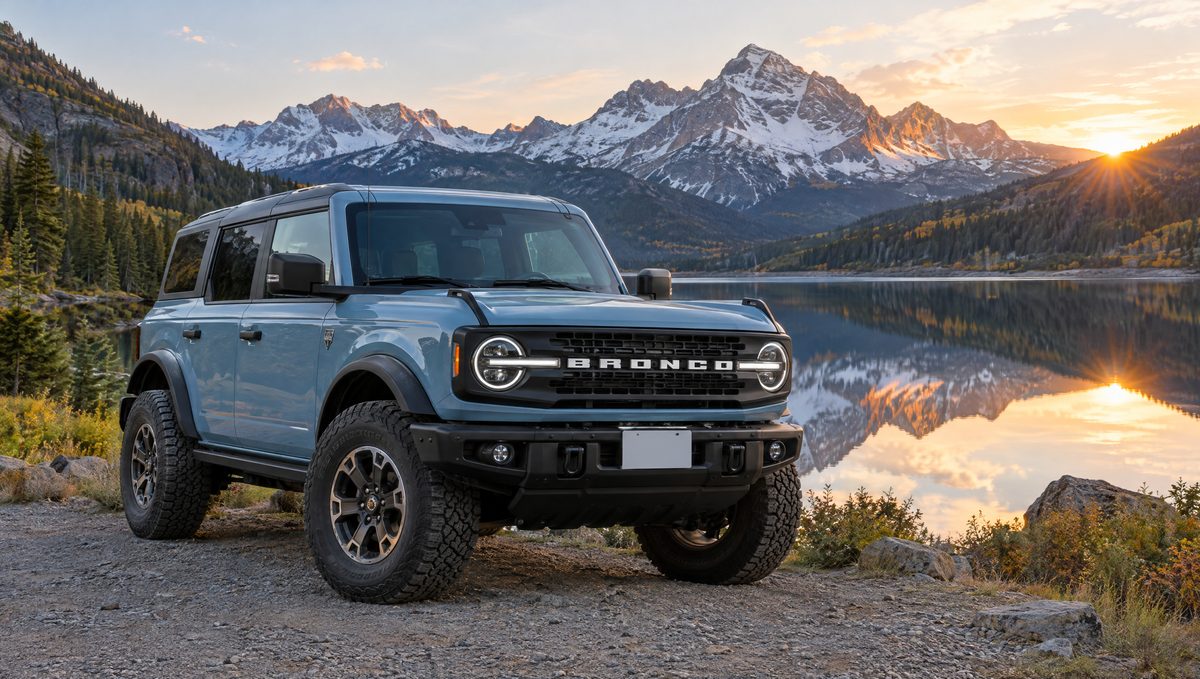
Ford Bronco review for Colorado buyers
The modern Bronco gives Colorado buyers serious trail hardware, removable tops and doors, and an independent front suspension that's easier to live with on pavement than a solid axle. Every one is a 4x4 with a two-speed transfer case, and the optional Advanced 4x4 adds an automatic mode that suits mixed winter roads. It's only been around since 2021, though, and the recall list is long. Pick the body style for how you'll really use it, and run the VIN.
AI-generated illustration of a Ford Bronco, not a specific vehicle for sale.
Verdict
- Trail use with a more civil highway ride
- Open-air summers in the high country
- Buyers who want a twin-turbo V6 option
- Small households and solo adventurers
- You need to tow more than 3,500 lb
- You want a long track record before buying
- You need a big cargo area in a two-door
- Fuel economy is a top priority
How it fits Colorado
Scored 1 to 5 for the way people here actually drive. These are our judgments, based on the facts below. Select a rating for the reasoning.
-
Advanced 4x4 with an automatic 4A mode handles changing pass conditions well, but base models use part-time 4WD and the traction law still comes down to tires.
-
Every Bronco engine is turbocharged, which holds power better at elevation than a naturally aspirated engine.
-
Ford rates most Broncos at 3,500 lb and the Raptor at 4,500 lb, which limits you to small trailers.
-
Ford lists up to 11.6 inches of ground clearance with the Sasquatch package and up to 13.1 inches on the Raptor, plus a two-speed transfer case on every model.
-
EPA ratings of 17-21 mpg combined depending on engine and package are typical for the class, and the independent front suspension helps on the highway.
-
The four-door seats five and is workable for a small family, while the two-door seats four with limited cargo space.
Which Bronco generation to look at
6th generation 2021-present
Body-on-frame 4x4 with removable doors and roof, offered as a two-door or four-door. Engines are a 300-hp 2.3L turbo four, a 330-hp 2.7L twin-turbo V6 and, on the Raptor, a 418-hp 3.0L twin-turbo V6, with a 7-speed manual offered on the 2.3L and a 10-speed automatic.
- 2.7L and 3.0L engine intake valve recall 24V635 on 2021-2022 models; the remedy includes an engine test and replacement as necessary
- Rear shock absorber corrosion recall 25V025 on 2021-2024 models
- Molded-in-color hardtop roof panel recall 26V299 on 2021-2022 models; Ford expected the remedy to be available in November 2026
- Front control arm and ball joint fastener recalls on certain 2024-2025 models (24V770, 25V308, 25V310)
- Transmission to transfer case joint recall 26V236 on certain 2021-2025 models that had a previous repair
Ford Bronco specifications
Figures vary by year, trim and configuration. Confirm the exact numbers for any specific vehicle before you rely on them.
- Drivetrain
- 4x4 on every model
- Standard part-time electronic shift-on-the-fly 4x4
- Advanced 4x4 with Automatic On-Demand Engagement (4A) optional or standard depending on trim
- Engine(s)
- 2.3L turbo I-4 (300 hp, 325 lb-ft), 2.7L twin-turbo V6 (330 hp, 415 lb-ft), 3.0L twin-turbo V6 on Raptor (418 hp, 440 lb-ft)
- Ratings on premium fuel
- 7-speed manual (2.3L only) or 10-speed automatic
- Seating
- 4 (two-door), 5 (four-door)
- Ground clearance
- 8.3 to 11.6 in depending on body and tire package
- 13.1 in on Raptor
- EPA fuel economy (combined)
- 2.3L: 19-21 mpg
- 2.7L: 18-20 mpg
- Sasquatch package: 17-18 mpg
- Raptor: 15 mpg
- Varies by year and configuration
- Towing (max, properly equipped)
- 3,500 lb (two-door and four-door)
- 4,500 lb (Raptor)
The Bronco for Colorado buyers
Two-door or four-door
This is the first decision, and it changes the vehicle more than any trim. The two-door seats four, and Ford's specs give it a better breakover angle than the four-door in the same configuration (28.9 degrees vs 26.3 with the Sasquatch package, for example). That shorter body is nice on tight switchbacks and narrow trails.
The four-door seats five, has real rear doors and much more usable cargo room. Its longer body is also steadier at highway speed. If the Bronco is your only vehicle, or you'll carry skis, dogs or more than one passenger regularly, the four-door is the one to buy. Ford rates both at the same 3,500-lb max towing, so towing isn't a reason to pick one over the other.
Buyers sometimes confuse the Bronco with the smaller Bronco Sport. The Bronco Sport is a smaller crossover, and this review covers only the full-size Bronco.
Part-time 4x4 vs Advanced 4x4 for Colorado roads
Every Bronco has a two-speed transfer case with low range. The standard system is a part-time, electronic shift-on-the-fly 4x4. You drive in 2H and switch to 4H or 4L when you need traction, and like any part-time system it isn't meant to stay in 4WD on dry pavement.
The Advanced 4x4 adds an electromechanical clutch and an automatic 4A mode that sends power to the front axle as needed. For Colorado winters, that's the setup most shoppers should want. A drive from Denver to Breckenridge can go from dry to slush to packed snow and back, and 4A handles that without you changing modes. Ford lists Advanced 4x4 as optional on the Base, Big Bend and Outer Banks and standard on trims like Badlands, so check the actual vehicle.
None of this replaces tires. When CDOT activates the traction law on I-70 between Dotsero and Morrison, you need at least 3/16 inch of tread on M+S, all-weather or winter-rated tires, or chains. The big all-terrain tires on many Broncos may or may not carry those markings, so look before you buy. Our winter buying guide covers tire checks.
Engines and altitude
All three Bronco engines are turbocharged. The 2.3L four makes 300 hp and 325 lb-ft and is the only engine offered with the 7-speed manual. The 2.7L twin-turbo V6 makes 330 hp and 415 lb-ft and comes with the 10-speed automatic. The Raptor's 3.0L twin-turbo V6 makes 418 hp. Ford's ratings are on premium fuel.
Turbocharging matters in Colorado. Turbo maker Garrett Motion says a naturally aspirated engine typically loses about 3 percent of its power for every 1,000 feet of elevation, and turbocharging recovers much of that loss. A Bronco climbing toward the Eisenhower Tunnel keeps more of its rated power than a non-turbo competitor would.
For most buyers, the 2.3L is plenty. The 2.7L is the pick if you drive passes often with a full load or a trailer, though EPA ratings are similar or slightly lower depending on year. Keep in mind that 2021-2022 2.7L Broncos are covered by an intake valve recall, so confirm the status on any used one.
Trail hardware and the Sasquatch package
Ground clearance varies a lot. Ford's specs show 8.3 inches on a base two-door with 30-inch tires, 10.5 inches with 33-inch tires, 11.6 inches on a two-door with the 35-inch Sasquatch package and 13.1 inches on the Raptor with 37-inch tires. Max water fording runs from 31.5 inches up to 33.5 inches with Sasquatch and 37 inches on the Raptor.
For Colorado forest roads and moderate 4x4 roads, a Bronco on 33s with Advanced 4x4 covers most of what owners will do. The Sasquatch package makes sense if you're running rocky, technical routes. It does cost fuel economy: EPA ratings drop to 17-18 mpg combined with Sasquatch on recent years.
Compared with the Jeep Wrangler, the Bronco's independent front suspension is the main philosophical difference. The Wrangler's solid front axle is the traditional rock-crawling choice, while the Bronco's setup is generally easier to drive on pavement. If you want a more conventional SUV with similar trail intent, the Toyota 4Runner is the other one to compare.
Removable tops, hail and winter
Broncos come with a soft top or a hardtop, and both doors and roof panels can come off. For a Colorado winter, a hardtop is quieter and better sealed. If you're buying a used 2021 or 2022 with the molded-in-color hardtop, check recall 26V299: Ford found that sections of the outer roof panel could separate, and the remedy, an inspection and hardtop replacement as needed, was expected to start in November 2026.
Hail is the other issue. Hardtops, hoods and fender flares all take damage, and replacing a Bronco top is not cheap. Inspect in good light and ask about claims history. Our guide to hail damage and used cars explains what to look for.
If you plan to pull the top for summer, ask whether the seller has all the pieces, the storage bags and any tools. Missing panels on a used Bronco are a common and annoying surprise.
Towing and what to check on a used Bronco
Ford rates most Broncos at 3,500 lb and the Raptor at 4,500 lb, properly equipped. That handles a small teardrop, a utility trailer or a pair of dirt bikes. It's not a camper hauler for the passes. If that's your plan, read our notes on towing a camper in the mountains.
The Bronco is still young, and it has collected a lot of recalls since 2021: air bags, rearview cameras, child locks, rear shocks, front control arm fasteners, the hardtop and engine valves among them. Many are fixed by now, but run the full VIN on NHTSA's site and ask for dealer paperwork.
If you want a specific body style, engine and 4x4 system, we can search for that exact Bronco and check its recall history before you commit.
Pros and cons
- Independent front suspension rides better on pavement than a solid axle
- Every engine is turbocharged, good for altitude
- Advanced 4x4 with an automatic 4A mode
- Up to 11.6 in of clearance with Sasquatch, 13.1 in on Raptor
- Removable doors and roof
- Manual transmission available with the 2.3L
- Towing tops out at 3,500 lb on most models
- Long recall list for a young model
- Base models use part-time 4WD
- Big tire packages cut fuel economy
- Two-door has little cargo room
Looking for a Bronco?
None listed at the moment. Tell us the year range, trim and budget and a broker will look for one that fits.
Ford Bronco questions
Is the Ford Bronco good in snow?
Yes, especially with Advanced 4x4, whose automatic 4A mode sends power to the front wheels as conditions change. Every Bronco has a two-speed transfer case and good ground clearance. As with any 4x4, tires decide how well it stops and turns, and Colorado's traction law requires proper tires or chains.
Should I get a two-door or four-door Bronco?
Get the four-door if it's your main vehicle or you carry passengers and gear. It seats five and has far more cargo room. The two-door seats four and has a better breakover angle on trails, so it suits solo drivers and weekend trail use.
What's the difference between Bronco part-time 4x4 and Advanced 4x4?
Part-time 4x4 lets you choose 2H, 4H or 4L, and shouldn't stay in 4WD on dry pavement. Advanced 4x4 adds an electromechanical clutch and an automatic 4A mode that engages the front axle as needed, which is easier for mixed winter roads.
Which Bronco engine is best for Colorado?
The 2.3L turbo four is enough for most drivers, and it's the only engine with a manual transmission. The 2.7L twin-turbo V6 adds torque (415 lb-ft vs 325) for loaded pass climbs. Both are turbocharged, so they hold power better at altitude than a non-turbo engine.
How much can a Ford Bronco tow?
Ford rates the Bronco at 3,500 lb, two-door or four-door, and the Bronco Raptor at 4,500 lb when properly equipped. That's fine for small trailers but not a mid-size camper.
What gas mileage does the Bronco get?
EPA ratings range from about 19-21 mpg combined for the 2.3L, 18-20 mpg for the 2.7L and 17-18 mpg with the Sasquatch package, depending on year. The Raptor is rated at 15 mpg combined.
What recalls should I check on a used Bronco?
Key ones include the 2.7L and 3.0L intake valve recall on 2021-2022 models, the rear shock corrosion recall on 2021-2024 models, the hardtop roof panel recall on 2021-2022 models and front control arm fastener recalls on some 2024-2025 models. There are many more, so run the VIN on NHTSA's site.
Is the Bronco hardtop a problem?
Certain 2021-2022 molded-in-color hardtops are under recall 26V299 because sections of the outer roof panel can separate. Ford planned an inspection and replacement as needed, with the remedy expected in November 2026. Check recall status on the VIN and inspect the top closely.
How we review
This is a buyer's review, not a road test. We compile facts from the sources below (manufacturer information, EPA fuel economy data, NHTSA recall records and similar), then add our view as a Colorado brokerage on how the vehicle suits winter, altitude, towing and trail use. Ratings are our editorial judgment. Specifications change by year and trim, so we confirm details for any specific vehicle before you buy. Spotted something wrong? Tell us and we'll correct it.
Sources
- Ford: 2026 Bronco Technical Specifications
- Ford: Bronco SUV, two ways to 4x4
- Ford: 2025 Bronco order guide
- Ford: 2026 Bronco Towing Guide
- fueleconomy.gov: 2021 Ford Bronco 4WD 2.3L
- fueleconomy.gov: 2024 Ford Bronco 4WD 2.7L
- fueleconomy.gov: 2024 Ford Bronco Sasquatch 2.3L
- fueleconomy.gov: 2025 Ford Bronco 4WD 2.3L
- fueleconomy.gov: 2025 Ford Bronco Raptor
- NHTSA recall 24V635 (2.7L/3.0L intake valves)
- NHTSA recall 25V025 (rear shock absorbers)
- NHTSA recall 26V299 (hardtop roof panels)
- NHTSA recall 25V308 (front lower control arm fasteners)
- CDOT: Colorado Traction Law
- Garrett Motion: How to turbocharge at elevation
Related reviews


