Toyota 4Runner review for Colorado buyers
The 4Runner is the body-on-frame SUV Colorado buyers ask about most, and for good reason: real low-range 4WD, good ground clearance and trims built for dirt. The 2010-2024 fifth generation is simple and old-school, with a 4.0L V6, a five-speed automatic and 17-18 mpg combined in 4WD form. The 2025 redesign adds turbo and hybrid power, more towing and better EPA numbers. Pick your generation by how you'll use it, then confirm which 4WD system the truck actually has.
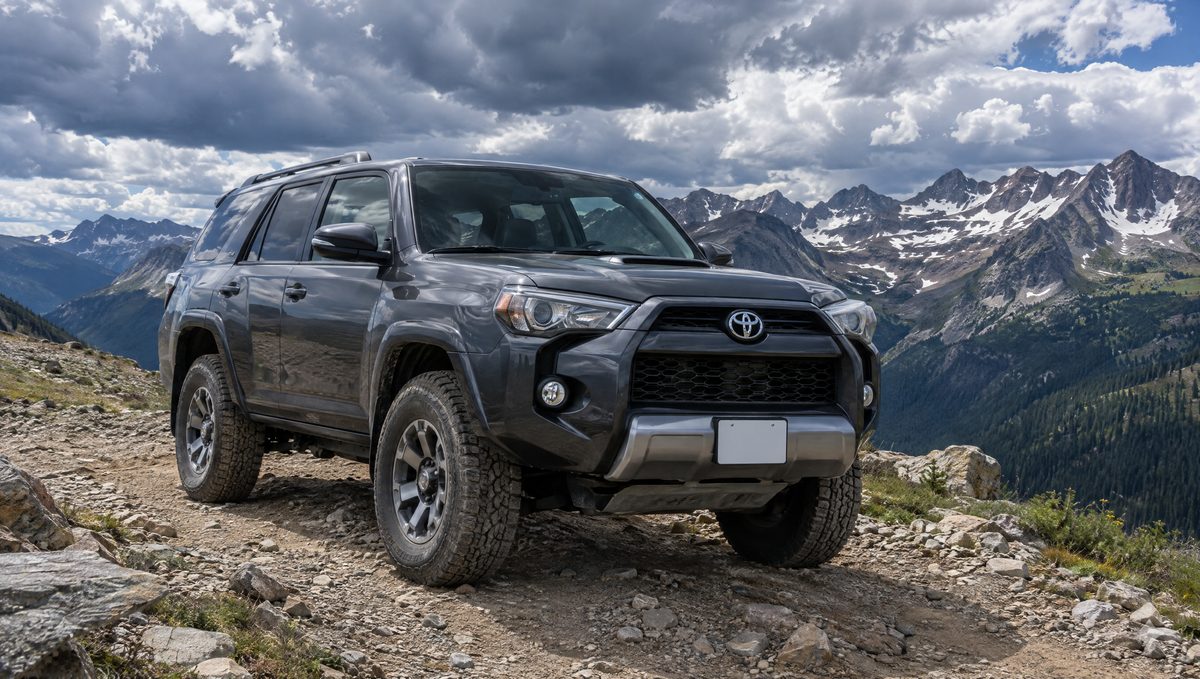
AI-generated illustration of a Toyota 4Runner, not a specific vehicle for sale.
Verdict
- Forest roads, trailheads and rough dirt
- Ski trips with gear and low-range backup
- Buyers who want a truck-based SUV
- Light camper or utility trailer towing
- Most of your miles are Front Range commuting
- You need a third row adults will tolerate
- You want car-like quiet and ride on I-70
- You plan to tow more than 5,000 lb with a fifth-gen
How it fits Colorado
Scored 1 to 5 for the way people here actually drive. These are our judgments, based on the facts below. Select a rating for the reasoning.
-
4WD 4Runners have low range on most trims plus traction aids, but Colorado's traction law is about your tires, so budget for good winter or all-weather rubber.
-
The fifth-gen's non-turbo 4.0L V6 gives up power as you climb, while the 2025-and-later turbocharged engines are better suited to thin air.
-
Toyota rates the fifth gen at 5,000 lb and the redesign at up to 6,000 lb, which covers small campers but not big travel trailers.
-
Body-on-frame construction, low range and trims like TRD Off-Road, TRD Pro and Trailhunter make it one of the most trail-ready SUVs on the used market.
-
EPA ratings of 17-18 mpg combined for 4WD fifth-gens make it a thirsty commuter; the redesign improves that to 21-23 mpg.
-
A third row is available, but most families use the 4Runner as a two-row SUV with a big cargo area.
Which 4Runner generation to look at
6th generation 2025-present
A full redesign with a 2.4L turbo four (i-FORCE, 278 hp, 317 lb-ft) or the i-FORCE MAX hybrid (326 hp, 465 lb-ft), an eight-speed automatic and up to 6,000 lb of towing. Trims run from SR5 and TRD Sport up through TRD Off-Road, Limited, TRD Pro, Trailhunter and Platinum.
- Instrument panel software recall 25V595 on certain 2025 models: speed and warning lights may not display at startup
- Load-capacity label recalls on some 2026 models (26V282, 26V571); check recall status and the door-jamb label
- Which 4WD system it has: part-time on most trims, full-time with a locking center differential on Limited and Platinum
- Hybrid vs gas: the i-FORCE MAX is standard on TRD Pro, Trailhunter and Platinum and optional on TRD Off-Road and Limited
5th generation 2010-2024
One powertrain for 15 years: a 270-hp 4.0L V6 with a five-speed automatic, refreshed for 2014. Most 4WD trims use part-time 4WD; the Limited got a full-time system with a locking Torsen center differential.
- Takata passenger air bag inflator recalls on 2010-2016 models, including 19V741; confirm the replacement was done
- Low-pressure fuel pump recall 20V682 on certain 2018-2019 4Runners
- Regional distributor accessory recalls (hood scoops, exhaust tips, wheel packages, labels); run the full VIN
- Trail and salt wear: look under skid plates, at rocker panels and along the frame on trucks that have seen hard use
Toyota 4Runner specifications
Figures vary by year, trim and configuration. Confirm the exact numbers for any specific vehicle before you rely on them.
- Drivetrain
- RWD or 4WD
- Fifth gen: part-time 4WD on most trims, full-time 4WD on Limited
- 2025+: part-time 4WD, or full-time 4WD with locking center differential on Limited and Platinum (varies by trim)
- Engine(s)
- 2010-2024: 4.0L V6, 270 hp, 278 lb-ft, 5-speed automatic
- 2025+: 2.4L turbo I-4, 278 hp, 317 lb-ft, or i-FORCE MAX hybrid, 326 hp, 465 lb-ft, 8-speed automatic
- Seating
- 5, or up to 7 with the available third row (varies by trim and year)
- Ground clearance (fifth gen)
- 9.6 in on 4WD models, 9.0 in on 2WD, per Toyota
- EPA fuel economy (combined)
- Fifth gen 4WD: 17-18 mpg
- 2025+: 21 mpg gas 4WD, 22 mpg gas 2WD, 23 mpg hybrid 4WD
- Towing (max, properly equipped)
- 5,000 lb (2010-2024)
- Up to 6,000 lb (2025+), varies by configuration
The 4Runner for Colorado buyers
Fifth gen or the 2025 redesign: which one fits you
The fifth-gen 4Runner ran from 2010 through 2024 with almost no mechanical change. Every one has the same 270-hp 4.0L V6 and five-speed automatic. That's the appeal for a lot of buyers: it's a known quantity, parts and know-how are everywhere, and the aftermarket for lifts, armor and racks is huge. The tradeoff is fuel economy. EPA rates 4WD versions at 17 mpg combined in the later years and 18 mpg on mid-2010s trucks.
The sixth generation arrived for 2025 with a 2.4L turbocharged four-cylinder (278 hp, 317 lb-ft) and an optional i-FORCE MAX hybrid version of it making 326 hp and 465 lb-ft. Both use an eight-speed automatic. EPA numbers jump to 21 mpg combined for the gas 4WD and 23 mpg for the hybrid, and Toyota raised max towing to 6,000 lb.
Our honest take as brokers: if you want the simplest, most proven 4Runner and you don't drive huge miles, a clean 2014-2024 truck is a strong buy. If you tow, live up high, or put a lot of highway miles on, the redesign's torque and efficiency start to earn their keep. Either way, the right trim and 4WD system matter more than the model year, so it helps to have someone hunting for the exact 4Runner you want.
Part-time vs full-time 4WD, and why Colorado buyers should care
This is the 4Runner detail that trips up the most shoppers. On the fifth gen, SR5, TRD Off-Road and TRD Pro 4WD models use part-time 4WD: you drive in rear-wheel drive and shift into 4HI or 4LO when you need it. Part-time 4WD isn't meant to stay engaged on dry pavement. The Limited was the exception, with full-time 4WD and a locking Torsen center differential, so it can run in 4WD on mixed snow and dry road without you thinking about it.
For 2025 and later, Toyota kept part-time 4WD on most trims and offers full-time 4WD with an electronic locking center differential on the Limited and Platinum. If your winter driving is Denver to Summit County with patchy snow and dry stretches, the full-time setup is easier to live with. If you mostly want low range for trail days and you're fine shifting into 4HI when the road turns white, part-time is simpler and works well.
Don't go by the trim name alone. Check the window sticker or the transfer case controls on the actual truck, because a Limited badge on a used 4Runner doesn't tell you its 4WD hardware with certainty, and 2WD versions exist in several trims.
Winter, I-70 and the traction law
4WD helps you get moving and keeps you from getting stuck, but it doesn't help you stop or turn. That matters because Colorado's traction law, enforced on I-70 between Dotsero and Morrison from September 1 to May 31, is about tires: you need at least 3/16 inch of tread on tires rated all-weather, M+S or winter, or you need chains or an approved traction device. CDOT recommends AWD or 4WD in the mountains, but 4WD alone doesn't satisfy the law.
So when you look at a used 4Runner, look hard at the tires. A lot of these trucks wear aggressive all-terrains, and some of those carry the mountain-snowflake symbol and some don't. Worn mud-terrains look tough and can be poor on packed snow and ice. Our guide to buying a used car for Colorado winters covers tread checks in more detail.
On the highway itself, the fifth gen feels like what it is: a tall, body-on-frame SUV with a five-speed. It's stable, but crosswinds on open stretches and long climbs to the tunnel make it work. The 2025 turbo engines have far more torque low in the rev range, which is what you want for passing and climbing at speed.
Trails, ground clearance and the TRD trims
This is where the 4Runner earns its reputation. Toyota lists 9.6 inches of ground clearance for 4WD fifth-gen models, and the part-time 4WD trims all have a two-speed transfer case with low range. TRD Off-Road models add trail-focused hardware, and the TRD Pro sits at the top of the off-road range. For the 2025 redesign, the TRD Pro and the new overland-focused Trailhunter both come only with the i-FORCE MAX hybrid, and the Trailhunter gets Old Man Emu shocks, a high-mount air intake and 33-inch tires from the factory.
For typical Colorado use, meaning forest service roads, rutted trailhead approaches and moderate 4x4 roads, a stock 4WD SR5 on good tires does more than most owners will ask of it. The TRD trims make sense if you're doing rocky, technical routes, or you want factory hardware you'd otherwise add later.
If you're comparing body-on-frame options, the Toyota Tacoma shares a lot of the same thinking in pickup form, and the Jeep Wrangler and Ford Bronco go further on trail hardware at the cost of comfort and enclosed cargo space.
Towing and the altitude question
Toyota rates every fifth-gen 4Runner at 5,000 lb with a 500-lb max tongue weight. The 2025 redesign is rated up to 6,000 lb, properly equipped, and Toyota ties that figure to the stronger frame and i-FORCE MAX powertrain. Check the specific truck's rating before you buy, since equipment matters.
Altitude is the part flatland reviews skip. As a general rule, a naturally aspirated engine like the fifth-gen 4.0L V6 loses roughly 3 percent of its power for every 1,000 feet of elevation, according to turbocharger maker Garrett Motion. Turbocharged engines like the 2025 4Runner's make up much of that loss. If you're pulling a camper over Vail or Monarch Pass, that difference is real.
A 5,000-lb rating works for small teardrops, utility trailers and light pop-ups. For anything heavier, or long grades loaded with family and gear, read our notes on towing a camper in the mountains and consider a full-size truck.
What to check on a used 4Runner
Run the VIN for open recalls first. On 2010-2016 trucks, confirm the Takata passenger air bag inflator work was done. Certain 2018-2019 models are part of Toyota's low-pressure fuel pump recall. Many 4Runners sold through regional distributors also had dealer-installed accessories that were later recalled, from hood scoops to exhaust tips to wheel packages.
Then look underneath. Trail rash on skid plates is normal on a truck that's been used as intended, but bent components, fresh welds or heavy rust from plowed-road salt deserve a closer look. Ask what modifications were made, since lifts and big tires change how a 4Runner rides, stops and handles in snow.
Hail is the other Colorado-specific issue. 4Runners have big, flat roofs and hoods, so check for dents in angled light and ask about any insurance claim history. Our article on hail damage and used cars explains what to look for and how it affects value.
Pros and cons
- Low-range 4WD on part-time 4WD trims
- Body-on-frame build that suits rough Colorado roads
- Fifth gen is mechanically simple and well understood
- 2025 redesign adds torque, efficiency and 6,000-lb towing
- Full-time 4WD option on Limited and Platinum
- Huge aftermarket for racks, armor and tires
- Fifth-gen fuel economy is poor at 17-18 mpg combined
- Non-turbo V6 feels the altitude on long climbs
- Third row is tight and cuts into cargo space
- Part-time 4WD shouldn't stay engaged on dry pavement
- Towing tops out well below full-size SUVs
Looking for a 4Runner?
None listed at the moment. Tell us the year range, trim and budget and a broker will look for one that fits.
Toyota 4Runner questions
Is the Toyota 4Runner good in snow?
Yes, a 4WD 4Runner on good tires handles Colorado snow well. Its 4WD and ground clearance help in deep snow and on unplowed roads. Tires matter most, though, and Colorado's traction law requires tires with at least 3/16 inch of tread rated M+S, all-weather or winter, or chains.
Does the 4Runner have full-time 4WD?
Only some do. On 2010-2024 models, the Limited had full-time 4WD with a locking Torsen center differential, while other 4WD trims used part-time 4WD. On 2025 and later models, full-time 4WD is offered on the Limited and Platinum. Check the actual truck, not just the badge.
Should I buy a 2024 4Runner or a 2025?
Buy the 2024 if you want the proven 4.0L V6 and simple mechanicals and you don't drive heavy miles. Buy the 2025 or later if you tow, drive a lot of highway miles or live at high elevation, since the turbo engines bring more torque, better EPA ratings (21-23 mpg combined vs 17) and up to 6,000 lb of towing.
How much can a 4Runner tow?
Toyota rates the 2010-2024 4Runner at 5,000 lb and the 2025 and later model at up to 6,000 lb when properly equipped. That's enough for small campers and utility trailers. For heavy trailers over Colorado passes, a full-size truck or SUV is the better tool.
Does the 4Runner have a third row?
A third row is available on some trims in both generations, bringing seating to seven. It's best for kids or short trips. Many buyers skip it to keep the full cargo floor.
What gas mileage does a 4Runner get?
EPA rates 4WD fifth-gen 4Runners at 17-18 mpg combined, depending on year. The 2025 and later gas 4WD model is rated at 21 mpg combined and the i-FORCE MAX hybrid at 23 mpg combined. Big tires and roof racks will pull real-world numbers lower.
Is the 4Runner hybrid worth it in Colorado?
It makes the most sense if you tow, climb passes often or want a TRD Pro, Trailhunter or Platinum, since those trims only come with the i-FORCE MAX. Its 465 lb-ft of torque is a big step up for mountain driving. EPA rates it at 23 mpg combined, 2 mpg better than the gas 4WD.
What recalls should I check on a used 4Runner?
Check Takata passenger air bag inflator recalls on 2010-2016 models, the fuel pump recall on certain 2018-2019 models, and instrument panel software recall 25V595 on certain 2025 models. Many trucks also have regional accessory recalls. Running the VIN on NHTSA's recall lookup covers all of it.
How we review
This is a buyer's review, not a road test. We compile facts from the sources below (manufacturer information, EPA fuel economy data, NHTSA recall records and similar), then add our view as a Colorado brokerage on how the vehicle suits winter, altitude, towing and trail use. Ratings are our editorial judgment. Specifications change by year and trim, so we confirm details for any specific vehicle before you buy. Spotted something wrong? Tell us and we'll correct it.
Sources
- Toyota Newsroom: The All-New 2025 Toyota 4Runner
- Toyota Newsroom: Five Things to Know About the All-New 2025 Toyota 4Runner
- Toyota Newsroom: 2025 Toyota 4Runner Refines Adventure Ready Heritage
- Toyota Newsroom: 2024 Toyota 4Runner: Rugged Capability
- Toyota Newsroom: Toyota 4Runner TRD Sport Added to Lineup for 2022
- fueleconomy.gov: 2015 Toyota 4Runner 4WD
- fueleconomy.gov: 2024 Toyota 4Runner 4WD (part-time)
- fueleconomy.gov: 2025 Toyota 4Runner 4WD (gas)
- fueleconomy.gov: 2025 Toyota 4Runner 4WD (hybrid)
- fueleconomy.gov: 2025 Toyota 4Runner 2WD
- NHTSA recall 19V741 (Takata inflators, 2010-2016 4Runner)
- NHTSA recall 20V682 (fuel pump, 2018-2019 4Runner)
- NHTSA recall 25V595 (instrument panel, 2025 4Runner)
- CDOT: Colorado Traction Law
- Garrett Motion: How to turbocharge at elevation
Related reviews


